





No Easy Fix To The Fuel Price Problem
Like all industries, the timber trade has been deeply affected by the sudden spike in fuel prices. Since the United States and Israel began their attack on Iran on 28 February, global oil prices have increased by 40% or more.
The result is soaring petrol and diesel prices, with knock-on effects for the entire South African economy, including our industry – although the petrol price has not risen as dramatically as one might expect, for reasons we’ll explain.
Between 7 January and 1 April this year, unleaded petrol rose by about 13% (from R19,92/litre to R22,53 at the coast and from R20,75 to R23,36 inland), and 50 ppm diesel by about 40% (from R17,58 at the coast and R18,41 inland, to R25,35 and R26,11).
Diesel users – including those in transport and agriculture – were hardest hit. Retail diesel prices in South Africa are not regulated, as petrol prices are, and diesel relies more on imported refined products.
The direct cause of those fuel price increases is the price of Brent Crude futures (futures are locked-in prices). Brent Crude is the trading classification for the types of petroleum – sweet crude oil and light crude oil – first extracted from the Brent oilfield in the North Sea, that serves as the primary benchmark for global oil prices. On 7 January, Brent Crude futures were trading at $60 per barrel; by 31 March, that price had almost doubled to $118.
Diesel users – including those in transport and agriculture – were hardest hit. Retail diesel prices in South Africa are not regulated, as petrol prices are.
Who sets the oil price?
Oil-producing countries, including the 14 member states of the Organisation of Petroleum Exporting Countries (OPEC), try to influence oil prices by manipulating supply. They do this by increasing, or decreasing, the supply of oil to the market. But OPEC doesn’t set oil prices. Neither does a government, nor your local fuel station.
The actual oil price is set by trades in the futures market (hence the “Brent Crude futures” mentioned earlier). The futures market is where investors buy or sell commodities at an agreed-upon price on an agreed-upon date in the future. Futures prices are largely based on sentiment, so when the general feeling is that the war in Iran will not end quickly and cleanly, that negative sentiment gets priced into Brent Crude futures.
It’s a double whammy for South Africa: oil costs more, and the currency we use it also costs more.
Brent Crude futures are only one element in oil pricing. The exchange rate is another. Oil is sold by the barrel, and those barrels are priced in US Dollars. Amid the geopolitical instability, emerging-market currencies like the Rand have weakened recently as investors pivoted towards “safe-haven” currencies such as the US Dollar.
It’s a double whammy for South Africa: oil costs more, and the currency we use to buy it also costs more.
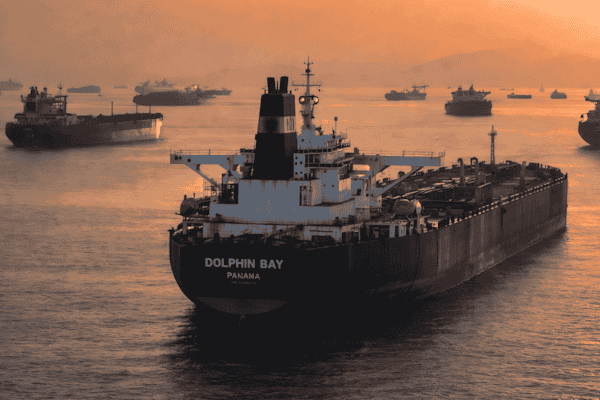
Another key factor is transport costs. About one-fifth of the world’s oil output travels via sea from the Persian Gulf through the Strait of Hormuz to the Indian Ocean, and then on to the rest of the world. Iran, located on the Strait’s north coast, has effectively blockaded traffic through the strait. And now the US is protecting its own allies in the Gulf. Some oil vessels have been bombed. Some have had to pay a “protection” fee. Others have simply sat at port. Insurance for these vessels has been cancelled in some cases, and in others, insurance costs have skyrocketed.
The upshot is that less oil is being transported through the Gulf than previously, and at greater cost.
What this means for South Africa
While South Africa imports some of its oil from Saudi Arabia, most of it comes from Nigeria, Angola, the US, and Brazil – none of which are directly affected by the stranglehold at the Strait of Hormuz. So why should the war in Iran matter to us?
The first thing to remember is that South Africa imports a lot of crude petroleum. In January 2026, we had a negative trade balance of $5.98 billion for this commodity. Regardless of where it comes from, the oil we buy is sold on the international market, its price determined internationally by Brent Crude prices and the other factors we described above.
There are no special deals for importing from our neighbours.
Regardless of where it comes from, the oil we buy is sold on the international market, its price determined internationally
The second thing is that, while South Africa was fuel-independent in the past, that’s simply not the case anymore. As commentator Dr Nik Eberl pointed out, “At the height of international sanctions during the apartheid era, South Africa faced severe restrictions on crude oil imports. In response, Sasol pioneered coal-to-liquids (CTL) technology at scale – turning abundant domestic coal into synthetic fuels.” In 2016, South Africa’s extensive fuel reserves were severely depleted, with about 10 million barrels sold at a discount, which was later ruled illegal by the High Court in 2020 due to corruption. As of early 2026, reserves were estimated at about 7.7 million barrels, covering only 12-17 days, significantly below the required 90-day standard.
Sasol doesn’t have the capacity to meet national demand anymore, and its synthetic‑fuel process is too expensive and too carbon‑intensive to scale to 100% of South Africa’s needs.
As the Fuels Industry Association of South Africa said, “For South Africa, a high reliance on imported crude oil and refined petroleum products means that developments in international energy markets have a direct impact on the country’s fuel supply dynamics and pricing environment.
“As a result, movements in global product prices together with fluctuations in the exchange rate remain the primary drivers of local fuel price adjustments.”
Local price add-ons
The Department of Mineral and Petroleum Resources (DMPR) explained that April’s fuel price increases were driven by crude oil prices, international petroleum product prices, the Rand/Dollar exchange rate, plus a list of local add-on costs.
These include transporting fuel inland (which explains the coast vs inland price differences), wholesale and retail margins (earned by suppliers and fuel stations), and various government taxes and levies (including the General Fuel Levy, Road Accident Fund Levy, Carbon Fuel Levy, and Customs and Excise taxes). Then there’s also the Slate Levy, which corrects the imbalances between the oil price (which moves daily) and the fuel price (which is adjusted monthly).
To ease the pain, Finance Minister Enoch Godongwana announced that the fuel levy would be temporarily lowered by R3 for the month of April. “I am still discussing what we can do for the next two months,” he said.
Ultimately, every extra levy contributes to the total cost of fuel at the pump – whether you’re buying retail for private use or wholesale for your business.
Effects on the timber trade
The increased fuel costs are widely expected to have an impact on the South African economy overall, and every sector within it.
“As a price-taker in the global oil market, the upward pressure on local fuel prices acts as a significant drag on consumer confidence and raises local transport costs,” warned Momentum Investments’ Chief Economist Sanisha Packirisamy. “With the Agricultural Business Chamber estimating that 80% of maize is moved by road transport, higher fuel prices bode ill for food inflation in the near term. Moreover, 80% of South Africa’s fertiliser is imported, providing further pressure.”
Crude oil is a vital ingredient in everything from petrol and diesel to fertilisers, lubricants, and plastics. Increased transport costs also have a knock-on effect on food, taxi fares, and any product that needs to be moved by road – including, of course, timber.
As Gavin Kelly, CEO of the Road Freight Association, explained, the daily basic diesel cost of South Africa’s road freight industry has risen by 32.5%. “That’s an increase of 32,5% of a basic cost input that is between 35% and 55% higher, depending on the vehicle type used, routes used, congestion, working conditions and fuel consumption,” he said.
Local trucking companies are able to get discounted diesel prices through co-ops – often at better rates than individual fuel stations
In the timber industry, transport costs can constitute one-third to one-half of the cost of the delivered product.
However, because diesel prices are not regulated (as petrol prices are), diesel suppliers can offer discounts or negotiated fleet deals. This means that local trucking companies are able to get discounted diesel prices through co-ops, which buy in bulk directly from wholesalers – often at better rates than individual fuel stations – to the benefit of some timber industry players.
Co-ops cannot and may not stockpile to save future costs. While they typically have good storage capacity, it is limited: petrol oxidises and loses octane over time, while diesel grows bacteria and fungi – literally turning to sludge.
Long-term stockpiling is both illegal and unsafe.
In the short term, though, co-ops are an attractive option for many in the timber trade. They operate on thin margins, focusing on serving their members rather than on retail profit – and the saving they offer on bulk fuel purchases can be significant.
Those margins will be squeezed, though, the longer the crisis in the Middle East continues.
Amid these complex factors the future remains uncertain, as is typical during international armed conflict.
“The situation in the Gulf is changing by the hour,” Bertus concluded. “For South Africans, and for the local timber trade, understanding the complexities behind the fuel price may help with budgeting and planning.
“History has shown us, over and over, that the days of doing ‘normal’ business are over. We, as businesses, need to learn – if we have not already learnt – how to adapt to uncertainty and extreme volatility.
Our hope is that the industry will see this latest shock as an opportunity, rather than a threat
“We have written extensively about how high-volume and low-margin business practices have led to sub-standard products in the market, as product prices have not increased with costs. Such companies have not been able to grow their business sustainably due to their business model.
“This oil-price shock poses a severe threat to such companies. Dolphin Bay firmly believes that our industry should be a prosperous one, where sufficient funds are generated to invest back into businesses: into technology and the betterment of a company’s employees, to build up our industry, and not just survive.
“Our hope is that the industry will see this latest shock as an opportunity, rather than a threat.”
Source: Dolphin Bay
Back to NEWS:
BUSINESS l CLIMATE CHANGE l CONSTRUCTION l EDUCATION l ENVIRONMENT l FORESTRY ENGINEERING FORESTRY l GOVERNMENT l INTERNATIONAL l LAND l RECYCLING l RESEARCH l ROOFING l SHORT HAUL SILVICULTURE l SOCIAL RESPONSIBILITY l TRANSPORT l TREATMENT l TRANSPORT l VALUE ADDING