








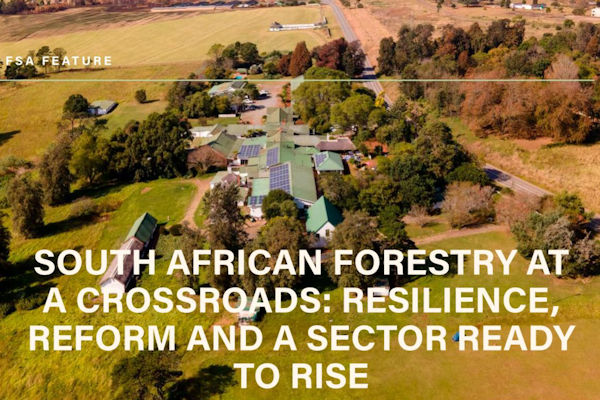
SA Forestry at a Crossroads: Resilience, Reform and a Sector Ready to Rise
South Africa’s Forestry Sector arrived at the 2026 Forestry South Africa (FSA) Annual General Meeting (AGM) with a hard-earned sense of realism. The past year has been marked by global volatility, domestic policy uncertainty and intensifying pressures from climate, security and logistical challenges. Yet what emerged from the AGM was not a narrative of strain, but one of resilient momentum. Across keynote addresses, leadership reflections and industry updates, the Sector presented itself as both grounded and forward-looking. It is fair to say that the South African Forestry Sector is a community that understands the weight of its challenges but is equally alert to the opportunities unfolding around it.
The global backdrop remains complex, with oil price spikes linked to conflict in the Middle East having pushed up costs across the value chain, while shifting geopolitical dynamics continue to reshape trade flows. Although many South African industries are exposed to the turbulence of US-related trade tensions, forestry is somewhat insulated by its limited direct reliance on the American market. There are opportunities on offer with the expansion of BRICS (already representing around 41% of global GDP), offering long-term promise for new markets, diversified partnerships and a broader economic horizon.
Domestically, the Sector has had to navigate its own structural constraints. A decade-long impasse on water-use licences, persistent rail and port inefficiencies, energy instability, regulatory backlogs and the growing threat of illegal mining and rural violence, have all weighed heavily on operations. Yet, as FSA Executive Director Michael Peter emphasised, the past year has also delivered meaningful breakthroughs. These have been driven by sustained industry advocacy, strengthened partnerships with government and a renewed willingness across departments to recognise forestry’s strategic importance.
Peter highlighted the scale of recent investment as a sign of confidence in the Sector’s long-term trajectory. Over the past six years, forestry companies have collectively invested R38 billion, a commitment that speaks to enduring demand for wood-based products and the Sector’s ability to generate stable returns. The Industry has also made strides in developing its future workforce, placing 133 previously unemployed forestry graduates through FSA’s employment programme, enabled through more than R20 million from the FP&M Seta.
Perhaps most striking has been the progress made through government partnerships. After years of frustration, the deadlock on water-use licences has finally been resolved, unlocking new afforestation opportunities. Energy reforms have opened the door for forestry companies to invest in renewable generation and contribute to the country’s energy security for the first time. Transnet has entered new collaborations to recapitalise rail rolling stock and port infrastructure, while visa reforms have eased access to international skills essential for plant maintenance and investment projects. Support from the Department of Transport for Performance-Based Standard vehicles promises to reduce truck numbers and logistic costs. The promise of additional provincial roads serving forestry operations is set to improve long-term road quality. Nearly R1 billion in empowerment funding has been channelled into black-owned forestry enterprises, while SAPS and SANDF have stepped up efforts to combat illegal mining and violence in forestry regions. Even the long-standing backlog in agrichemical registrations, a threat to international certification, has been tackled by the Department of Agriculture with the deployment of 27 private-sector experts. Signifying a lot for the Forestry Sector to celebrate.
These reforms have unfolded alongside a major structural shift in logistics. For the first time, 11 private train operators have been granted access to the national rail network. Ports and rail reform will inevitably move more slowly than energy reform, given the capital and complexity involved, but the direction of travel is unmistakably positive. Forestry continues to play a central role in the National Logistics Crisis Committee, Operation Vulindlela, the National Planning Commission and other presidency-level structures, ensuring the Sector’s voice is present where national decisions are shaped.
Against this backdrop of reform and renewal, political economist JP Landman delivered a keynote that blended clarity and cautious optimism. Known for his unsettling accuracy in forecasting South Africa’s political and economic shifts, Landman argued that the country is in a period of messy but meaningful transition. The formation of the Government of National Unity, he suggests, has introduced friction but also forced collaboration and policy continuity, a development that matters deeply for long-term industries such as Forestry. For Landman, the real story lies not in the headlines but in the underlying trends, which point towards gradual strengthening rather than decline.
For a Sector that plans in decades rather than quarters, this perspective resonates strongly. Forestry depends on policy predictability and economic resilience. Landman’s analysis suggested that they are slowly improving. His message was not one of blind optimism, but of informed confidence: South Africa is moving, sometimes haltingly, in the right direction and forestry is well-positioned to benefit from the shifts underway.
If Landman provided the macro-lens, Dr Kabir Peerbhay, Sappi’s Principal Research Officer, delivered the technological one. His presentation on the Sappi drone programme was nothing short of transformational, revealing a Sector that has moved far beyond traditional methods, embracing unmanned aerial vehicles, AI-driven analytics and real-time data as essential tools of modern forestry. What once seemed essential has now become an embedded practice, supporting silvicultural audits, stock measurements, fire-risk assessments, disaster mapping, security surveillance and environmental compliance.
Peerbhay explained how the shift from visual line-of-sight to beyond-visual-line-of-sight operations mirrors the broader evolution of forestry itself, with the industry no longer constrained by what the human eye can see or what manual methods can deliver. Equipped with survey-grade sensors, LiDAR, thermal cameras, gas detectors and live-streaming capabilities, drones now provide high-resolution, near-real-time intelligence that is reshaping decision-making across the value chain.
He covered AI-powered analytics and how they are unlocking insights that were previously impossible, detecting seedlings in complex ground conditions, identifying grazing damage, assessing residues and supporting breading trials with remarkable accuracy. Fire management has been revolutionised, with thermal sensors detecting hotspots invisible to ground crews. Environmental monitoring has entered a new phase, with drones mapping fugitive gas emissions and identifying leaks in mill infrastructure. Even security operations have been transformed, with drones enabling safer, more effective monitoring of illegal mining and nighttime activity.
Peerbhay’s message was clear: UAV technology is no longer optional. It is foundational to productivity, risk management, environmental stewardship and global competitiveness. For a Sector facing climate volatility, rising costs and increasing scrutiny, drones offer not just better data but a fundamentally new way of seeing and managing South Africa’s forests.
Bringing these threads together, FSA Chair and Sappi Forests Vice-President Duane Roothman offered a reflection grounded in the character of the Sector itself. He describes a year of turmoil, but also one that has reaffirmed forestry’s defining quality of resilience, adaptability and collaboration. “We are anchored in the earth,” he said, making it clear that the Industry’s strength lies not only in its technical capabilities but in its power: their ability to work together, to question what they do and why, and to hold fast to the principles and values that have carried the Sector through turbulent times.
He urged the Industry to focus on its successes rather than its frustrations, to build on the relationships that have delivered progress and to embrace the partnerships that define the shared landscape of forestry, agriculture and rural development. Roothman spoke of the importance of intergenerational leadership, celebrating emerging talent capable of navigating both technical complexity and South Africa’s diverse social fabric. His closing sentiment captured the spirit of the AGM: “Talk less, do more and collaborate relentlessly.”
Taken together, the 2026 FSA AGM painted a picture of a Sector at a crossroads, challenged, certainly, but far from overwhelmed. It is a Sector confronting global volatility while finding new markets, navigating domestic constraints while unlocking reforms, rooted in tradition while embracing technology and facing climate and security risks while innovating faster than ever. Every message, from Landman’s macro-analysis to Peerbhay’s technological vision, from Peter’s reform-driven progress report to Roothman’s call for principled collaboration, was consistent: South African forestry is not waiting for the future, it is actively shaping it.”
Written By: Dr Ronald Heath, FSA Director of Research and Protection
Source: Forestry in Focus
Back to NEWS:
BUSINESS l CLIMATE CHANGE l CONSTRUCTION l EDUCATION l ENVIRONMENT l FORESTRY ENGINEERING FORESTRY l GOVERNMENT l INTERNATIONAL l LAND l RECYCLING l RESEARCH l ROOFING l SHORT HAUL SILVICULTURE l SOCIAL RESPONSIBILITY l TRANSPORT l TREATMENT l TRANSPORT l VALUE ADDING


