





Forestry Facts: E. grandis x E. smithii
Eucalyptus smithii is an important and profitable species for NCT, its members and its customers (end-users of wood chips). Eucalyptus smithii produces high volumes when planted on suitable sites and has favorable properties for pulp production (that is, density in the 600 (kg/ m3 range and pulp yield of approximately 56%).
Its high-density benefits both NCT members and customers: members can sell more tonnage over the weighbridge, while customers maximize stowage capacity, gaining more utilisable wood material per shipment for pulp production.
The land base planted to E. smithii and/or the expansion of areas planted to E. smithii are however limited by climate and Phytophthora spp. (disease causing pathogens). In past years there have been many projections about a warming climate, and we are experiencing that reality today! The high susceptibility of E. smithii to Phytophthora has made the planting of the species, particularly in northern KwaZulu-Natal and southern Mpumalanga unfeasible and unprofitable.
Hybridisation and clone testing:
To overcome the constraints associated with E. smithii expansion NCT, in 2007, teamed up with the Council for Scientific and Industrial Research (CSIR) to develop and plant a E. grandis x E. smithii hybrid progeny trial. Unlike E. smithii, E. grandis can be planted in warmer climates and is tolerant to Phytophthora. Combining the two species overcomes the limitations of E. smithii as a pure species.
In 2015/2016 sixteen E. grandis x E. smithii hybrid clones selected from the 2007 progeny trial were further tested by the Hybrid Clone Consortium (HCC). HCC is a non-profit organisation that screens and tests clonal material for commercial forestry production. HCC members include NCT, TWK, and various private commercial nurseries. In 2022, HCC released the first E. grandis x E. smithii hybrid clone (GS 211) for commercial production. GS 211 is currently available at Sunshine Seedlings, Ezigro Seedlings, CPS Seedlings and Sutherland Seedlings.
Growth performance of GS 211 compared to E. smithii:
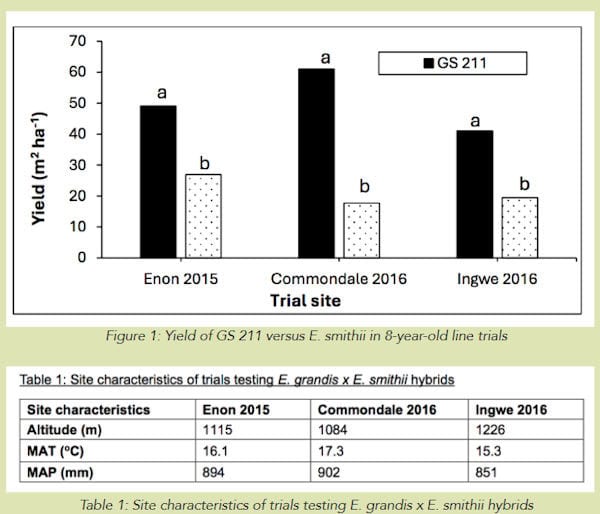
GS 211 shows promise as a high yielding hybrid in the KwaZulu-Natal midlands and southern Mpumalanga. Across a range of trials, the yield is significantly better than E. smithii.
Letters denote significant differences (p<0.05). Within the same trial, bars with different letters are significantly different from each other.
Pulping properties of GS 211 compared to E. smithii:
In 2023, NCT commissioned Sappi Technology Centre to conduct pulping studies on two E. grandis × E. smithii hybrids (GS 211 and B 223) together with E. smithii. The results showed that the E. grandis × E. smithii hybrids had a pulp yield comparable to E. smithii but exhibited superior pulp and paper-making properties. GS 211 had the highest tensile, burst and tear strength, followed by B 223, then E. smithii. The hybrids do, however, have a lower basic density compared to E. smithii. These Sappi results were confirmed by the Hokuetsu Corporation (HKP) in September 2024.
R50/tonne price premium for E. grandis x E. grandis mill deliveries:
HKP have agreed in principle for wood from the hybrid to be mixed in with E. smithii shipments, but they are concerned about the effect that the lower density will have on stowage. For this reason, a price premium of half of the E. smithii price premium will be offered to members for all E. grandis x E. smithii mill deliveries. NCT is encouraging members to plant hybrids on sites that are not suitable for E. smithii.
Site requirements and recommendations:
- Altitude between 800 m to 1300 m
- Avoid frost prone sites and/or frost pockets
- Areas previously limited by Phytophthora such as in southern Mpumalanga and northern KwaZulu-Natal
- Can be planted on margin E. smithii sites
The future of the E. grandis x E. smithii hybrid:
GS 211 has a lower wood density and oil content compared to E. smithii. Future efforts will focus on identifying high-yielding hybrids with wood density comparable to or greater than E. smithii, together with higher oil content.
Furthermore, the hybrid will continue to be tested across a range of mean annual precipitation and temperature conditions to further refine and expand its site suitability requirements.
Source: NCT