





Low Density Challenges In The Woodchips Of E. Smithii And Acacia Mearnsii
During the past year, NCT’s main wood chip customers in Asia have expressed concern about a decline in wood chip quality,particularly in wood density. This is a serious issue because it affects: the financial outcomes for our customers; trust and confidence in NCT as a supplier of high-quality wood chips; and potential implications for the end-product, especially if species other than Acacia mearnsii or Eucalyptus smithii are inadvertently included in pure loads.
E. smithii and Acacia mearnsii are premium species for NCT because of their favorable wood properties for pulping and their high wood density. High-density loads optimise transport and logistics’ costs, making operations more profitable for customers. NCT’s long-standing reputation as a trusted supplier is built on consistent quality; maintaining this trust is crucial for the integrity, stability, and sustainability of NCT and its members.
Differences in wood density of various Eucalyptus and Acacia species.
While the cause of reduced wood density is still under investigation, foresters and plantation managers must exercise due diligence to ensure compartments remain pure and that loads are not mixed.
Different species exhibit distinct wood properties (including but not limited to chemical composition, fibre strength and lengths, wood density), which influence not only transport efficiency but also downstream processing operations (such as cooking times and chemical use during cooking and bleaching stages). Table 1 summarizes the different wood densities reported in literature and in internal research trials for common Eucalyptus and Acacia species. It is acknowledged that wood density does vary across sites and with age.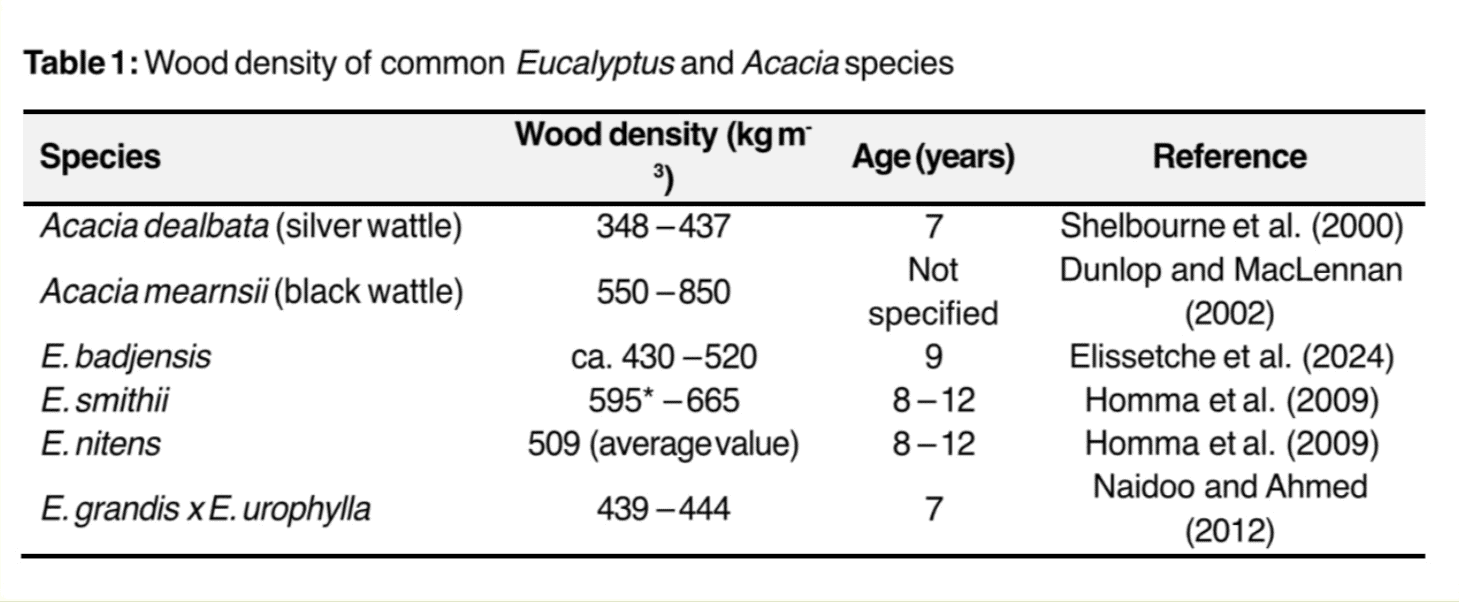
Although E. badjensis looks like E. smithii, it has a lower wood density and pulp yield (Table 1). Vessel loads are contracted in tonnes, but mill production depends on the quantity of usable wood material delivered. When lower-density species are included in loads intended to be pure, the effective wood material per shipment decreases. A load containing contamination with E. badjensis therefore delivers less E. smithii-equivalent material than expected. This reduces transport efficiency and may require additional vessels to meet supply targets, or results in lower-than planned production at the mill.
Similar considerations apply to black wattle and silver wattle, which are sometimes inadvertently or deliberately mixed. These species differ in wood density and fibre characteristics. When loads intended to be pure are mixed, the effective wood material delivered per tonne changes. As with Eucalyptus, this reduces transport efficiency and can result in under-delivery against contracted volumes.
In addition to transport implications, mixed species loads affect downstream processing. While mills are generally capable of handling mixed chip streams, the proportion of different species is critical for optimizing processing conditions. Variations in wood density, fibre characteristics and chemical composition influence chip packing, pulping efficiency and final product yield.
Ensuring species purity, or at minimum controlling species composition within defined limits, is therefore important for maintaining predictable and efficient processing performance.
Written By: Noxolo Ndlovu – Forestry Research Scientist
Source: NCT
Back to NEWS:
BUSINESS l CLIMATE CHANGE l CONSTRUCTION l EDUCATION l ENVIRONMENT l FORESTRY ENGINEERING FORESTRY l GOVERNMENT l INTERNATIONAL l LAND l RECYCLING l RESEARCH l ROOFING l SHORT HAUL SILVICULTURE l SOCIAL RESPONSIBILITY l TRANSPORT l TREATMENT l TRANSPORT l VALUE ADDING