





Well-Placed Poplar Plantations Can Enhance Forest Connectivity For Birds
A new study published in Landscape Ecology shows how fast-growing poplar plantations can improve functional connectivity for forest birds in fragmented agricultural landscapes, provided they are strategically located and species have moderate to high dispersal capacity. The findings suggest that managed forests may contribute not only to biomass supply, but also to biodiversity conservation in highly human-modified regions.
Using spatial connectivity models in two European river sub-catchments in Spain and France, researchers examined how existing forest patches, both within and outside Natura 2000 areas, and poplar plantations interact to support movement across the landscape for three forest bird species with contrasting dispersal abilities.
“Plantations can act as stepping stones between forest patches, although their effectiveness depended strongly on their location within the landscape,” says Sara Pineda-Zapata, a Doctoral Researcher at the University of Eastern Finland and the lead author of the study. “We wanted to understand whether plantations, often viewed only through the lens of wood and biomass production, could also support ecological processes in fragmented landscapes,” she continues.
In Spain, plantations generated connectivity gains that were greater than their area would suggest, with some patches playing an important role in maintaining ecological connectivity for forest networks, including Natura 2000 areas. In France, plantation patches were more isolated and contributed less effectively. The strongest benefits were observed for species capable of moving over longer distances; for short-distance dispersers like the common chaffinch, plantations had a more limited effect unless they were located very close to an existing forest habitat, suggesting that even narrow gaps can remain major barriers for less mobile species.
“Plantations are often assessed only in terms of production, but when strategically located, they can provide much more than wood. They can contribute to landscape structure, help maintain ecological flows and complement conservation efforts in intensively used agricultural regions. The key message is that location matters, and that planning matters,” says Professor Blas Mola at the University of Eastern Finland.
Professor Alejandra Morán of the University of Basel in Switzerland highlighted that the results are relevant beyond bird movement: “Connectivity influences how species move, persist and respond to environmental change. When we think about ecosystem services, we should consider not only what land use produces in one place, but how it shapes ecological processes across the wider landscape.”
Rémi Duflot, from the University of Jyväskylä, emphasised the broader implications: “Birds are particularly informative because they respond quickly to landscape fragmentation. However, we caution that plantations cannot replace natural forests in ecological quality, and that increasing tree cover may reduce habitat for open-habitat species, while forest specialists often require more complex structures than plantations provide.”
“What our results show is that in fragmented landscapes, well-placed plantations can become part of the solution, opening up interesting possibilities for designing productive landscapes that are also more supportive of biodiversity,” concludes Pineda-Zapata.
For further information, please contact:
Doctoral Researcher Sara Pineda-Zapata, spineda@uef.fi
Research article:
Pineda-Zapata, S., Morán-Ordoñez, A., Mola-Yudego, B., Duflot, R. Strategic placement of plantations enhances forest connectivity for birds in agricultural landscapes. Landsc Ecol 41, 54 (2026). https://doi.org/10.1007/s10980-026-02316-z.
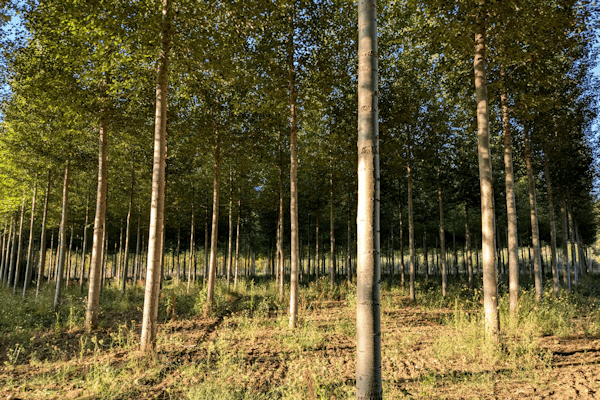
Image caption: A poplar plantation in Spain.
Image copyright: Sara Pineda-Zapata
Source: University of Eastern Finland
Back to NEWS:
BUSINESS l CLIMATE CHANGE l CONSTRUCTION l EDUCATION l ENVIRONMENT l FORESTRY ENGINEERING FORESTRY l GOVERNMENT l INTERNATIONAL l LAND l RECYCLING l RESEARCH l ROOFING l SHORT HAUL SILVICULTURE l SOCIAL RESPONSIBILITY l TRANSPORT l TREATMENT l TRANSPORT l VALUE ADDING